



archives
A, B, C, D, E, F, G, H, I, J, K, L, M, N, O, P, Q, R, S, T, U, V, W, X, Y, Z, 0, 1, 2, 3, 4, 5, 6, 7, 8, 9

Credit: Nick Fierro (writer),   Jonathan Pushnik (photographer)  

Ryan Matthew Cohn, star of Science Channel’s Oddities, deals in antiques, owns a boutique clothier, and creates skull showpieces that sit in elite tattoo shops. His love for polished ephemera is seen throughout his fantastical home— and in his neotraditional ink.


IT’S BARELY NOON ON A QUIET STREET IN BROOKLYN. The air is crisp and there is not a footstep to be heard on either side of this historic boulevard lined with century-old houses and brownstones, each edifice cracked and noble in the display of its age, proud. And yet, all that can be seen through each and every window of these grand structures is the same sets of curtains, the identical flat-screen TVs, and row after row of wall de?cor meticulously placed in catalog fashion. The street appears the same as any other in the city—that is, until a door opens, and out walks a figure in a finely tailored bespoke suit with shined shoes and a huge bag of trash under his arm. Suddenly something changes; this is no longer another building along the row, but the home and live-in museum of Ryan Matthew Cohn, whose fascination with the grotesque and enigmatic sets him apart from most collectors in the antique field.

Some might recognize Cohn as the resident bone collector and artifact picker for the Science Channel’s Oddities, a reality series centered around Obscura Antiques & Oddities, a peculiar antique shop in the East Village of Manhattan. Although he is known to the TV-watching public as a dissector of bones and picker of the bizarre, he is also an artist, jeweler, craftsman, and historian with a surprising amount of concealed ink. Collector, however, seems to be the most apt description for Cohn, whose home would probably turn Robert Ripley or P.T. Barnum a pale shade of green with envy.

A unique collection of skulls and artifacts such as Cohn’s does not manifest itself overnight, nor can it be acquired through a single means of instruction. It is the byproduct of a life spent in pursuit of something new blended seamlessly with the arcane. “As kids, we weren’t really allowed inside. Growing up in the nature of upstate New York lends itself to finding things and learning about what’s going on around you—death being one of those things,” says Cohn. As he explains the roots of his obsession with the macabre, Cohn is perched in an overstuffed, turn-of-the-century chair. To his right is a series of antique glass domes, each housing a skeletal anomaly, a medical curiosity, or an artifact imbued with the spirit of the collector. “I was a pretty obsessive-compulsive kid—whether it was skeletons, fish, or baseball cards, I was always collecting something,” he says. “Throughout my life it would constantly change genres, until it finally moved back to the natural history aspect in my 20s, when I got heavily into collecting it, seeking it all over the place. And now I’m really kind of all over the world seeking specific things.”

Cohn’s interest in antiques and artifacts led him to New York City when he was younger. “Right after high school I was working odd jobs at an antique store in Park Slope,” he says. “I was getting bored and was desperate for something new to do. A girl that I was seeing at the time was a bookkeeper for a jeweler.” The jeweler, whom he came to work under, turned out to be Arnold Goldstein, the original jewelry maker for Ralph Lauren. The job “took on every- thing else that I was doing at the time—antiques, fabrication, restoration—it all goes hand in hand.”

This correlation between creating something new that embodies the classic, the old, and the curious ultimately inspired Cohn to create something he could not find: a Beauchene skull. In a practice not seen since the 1800s, Cohn disassembles a human skull and—using a series of wires, brackets, and tiny screws (all handmade, of course)—arranges the component parts to make them appear as if they’ve stopped in midair during an explosion. “My personal aesthetic is antiques,” he explains. “I try to give every piece that I do a real antique feel.”

Antiques are more than just an aesthetic to Cohn; they embody a history, a technique, a story. The ceil- ing of his home is lined with antique lighting from the ’20s and ’30s that he’s rewired and restored. “The fake stuff, that’s easy,” he casually mentions as he looks toward one particular fixture. “That’s why people like it so much. I was buying a blanket at Restoration Hardware, and as it turns out, almost everything in my apartment is being reproduced by them. That’s when you know you’ve got something good.”

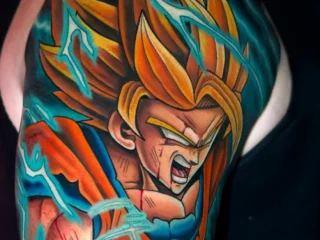
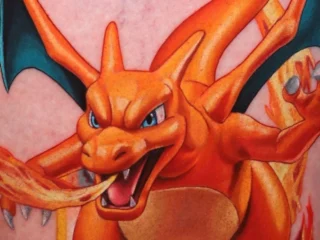
As a tattoo collector, Cohn’s interests tend toward the classic. His tattoo collection started with a dragon tattoo he got at 16. “I think I was the first kid in my school to get a tattoo, and it was a big one,” he says. “I’ve been collecting tattoos for a long time. In my 20s a lot of my friends were either starting out or becoming established tattoo artists, so I became the guinea pig, as many youngsters do. I started getting pieces here and there over the years.” Since then he’s traded skulls and antique ephemera for ink from the likes of Hand of Glory’s Craig Rodriguez, Smith Street Tattoo Parlour’s Steve Boltz, and Fun City Tattoo’s Big Steve.