


Jones’s lack of interest also extends to talking about his tattoo work. When asked to describe his ink, he curtly responds, “I have a bunch of crap, that’s the best explanation,” before telling a story about how he got his first tattoo from a coked-up biker while he was in his early 20s. “The guy would stop and take a break, and when he’d come back to start tattooing again he’d be wiping his nose,” he explains. “I was looking up at this guy going, ‘What’s happening? I don’t get this,’ because I had no idea what he was doing. And when I look back I go, ‘Oh, I get it now.’ If I had known then, things might have been different,” he adds. So what exactly did this coked-out biker actually ink on the frontman? “Bad art,” Jones responds. “Next question.”
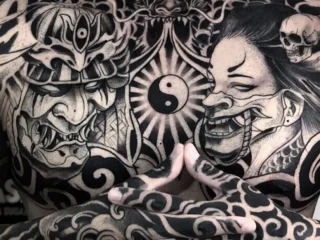
Although D’Antonio has his share of regrettable ink, he’s more interested in discussing his tattoo experiences. “My learner’s permit actually said [my birthday] was five months earlier than my actual birthday, so the day that it said I turned 18 I went to Tattoo America and got some flash off the wall,” he recalls. “I got this pretty terrible sun on my back that I wish I’d never got, but from then on I was hooked.” Now that he’s in his mid-30s, D’Antonio is far more confident about what type of art he chooses to have immortalized on his body, most notably a three-quarter sleeve of Japanese art that was influenced by the ’70s anime cartoon Force Five. “When we went over to Japan for the first time and I noticed that they had all these robots everywhere, I re-fell in love with the artwork and everyone just having so much respect for each other over there,” he says. “What goes into Japanese art is just so amazing.”
While the band don’t show much of their ink in photo shoots, the best place to check a glimpse is their explosive—and fun—live shows, where you might see Dutkiewicz running circles around the stage in short shorts or Jones making self-deprecating jokes between songs. “We think that the metal world takes itself way too seriously,” Dutkiewicz says. “There’s no smiling going on onstage for three-quarters of the metal world, and I think that’s unfortunate. We enjoy ourselves, we have a good time, and we want the crowd to have fun too—we don’t want them to bring their problems to the show. We want them to release them and have fun.”
Jones shares a similar outlook with D’Antonio when it comes to the band’s tendency to swim against the metal world’s preconceived norms. “I think there’s a place for everything when it comes to metal, and our place is to be silly and do what we do,” he says. “We don’t emulate anyone; we just go onstage and try to enjoy ourselves. And at the end of the day, if you can walk away from a show—whether you played it or watched it—and you enjoyed it, that’s its own reward.”
While many acts are fixated on sales and chart position, Killswitch Engage are content simply to play music and have a realistic approach when it comes to long-term expectations. “We’re not going to be the Rolling Stones or U2; we’re not going to be around for 30 years doing this,” Jones acknowledges. “So we do our best and then say, ‘Let’s chill out, have a good meal, and do something fun.’ And for me, I want to go fishing.”