



archives
A, B, C, D, E, F, G, H, I, J, K, L, M, N, O, P, Q, R, S, T, U, V, W, X, Y, Z, 0, 1, 2, 3, 4, 5, 6, 7, 8, 9

images/articles/Fetterman_header_.jpg

Credit: Joy Manning (writer),   Chris Casella (photographer)  

The 10-mile car ride from Pittsburgh to Braddock, PA, is littered with signals that you’re headed to the wrong side of town. Through the depleted neighborhoods of Swissvale and Rankin, you can’t miss the decay. Paint peels in big, desiccated flakes from crumbling buildings; trash tumbleweeds blow past shuttered pawn shops with faded signs that read “We buy gold.” When you arrive in Braddock, the site of Andrew Carnegie’s first steel mill, the feeling is desolate—at least until you hit Library Street, the block where Mayor John Fetterman lives.

On basketball courts whose asphalt is so conspicuously new they don’t seem to belong to the dilapidated town, a dozen black teenagers in high-top sneakers or plastic sandals and socks shoot hoops. It’s Community Day in Braddock, and these kids are warming up for the basketball tournament that coincides with the festivities. For many of them, the inflatable slide and basketball games will be the undisputed highlight of the summer. Just off the courts paces 40-year-old John Fetterman, a white Harvard grad who looks a little uncomfortable passing a basketball from one of his giant paws to the other. He is Braddock’s unlikely mayor, the man who built these courts, and the primary organizer of this league. “Football is really more my sport,” says Fetterman.

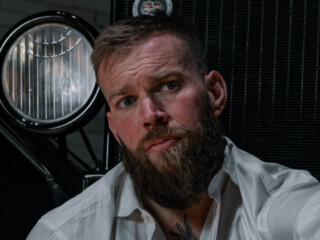
At 6´8´´ with a broad barrel of a torso, Fetterman commands respect from the kids even in the absence of basketball prowess. In his long, loose denim shorts and Dickies work shirt, he doesn’t look the part of an elected official—or Ivy League grad, for that matter. He looks like a professional wrestler off the clock and out of costume. His shaved head, overgrown goatee, and tattoo that reads I will make you hurt lend him a menacing aspect, but his light gray eyes brim with the seriousness and intensity of a man who sees his job as a ministry, as though there were no work more urgent on the planet and it’s up to him to save the world. Or at least this one tiny town.

“Today is not just about basketball,” he says. “It’s about doing something about the dearth of recreational activities here, giving these kids something to do instead of get in trouble, giving them mentorship, guidance, hope.” He proudly avers that there have been none of the problems that the community feared might accompany the courts: No loitering. No vandalism. No violence. No drugs. “It turns the stereotype—that these kids are nothing but trouble, problems—on its head,” he says. And even people who had those concerns have since admitted, according to the mayor, that the basketball games beat the abandoned, overgrown lot that recently marked this spot.

When Fetterman was earning his MBA in the ’90s, he never imagined he’d be celebrating his 40th birthday in a town with a population of less than 3,000. He certainly didn’t consider the possibility that his future job would pay an annual salary of just $1,800 and that he’d funnel that meager sum right back into the borough. Like most business school students, he saw a flush future in the money business, as a trader or banker, living the kind of life in which $1,800 might be a single night’s bar tab. But that version of John Fetterman abruptly vanished 16 years ago when his best friend was killed in a car wreck. Fetterman had been waiting to meet him for one of their routine trips to the gym. “When I got the call, time slowed down,” he says. “I was in my mid 20s, but suddenly everything changed. I was in the final months of completing my MBA, but I knew that finance was something I would never pursue. I had to find something that was really meaningful to me.”

Fetterman finished his MBA, but upon graduation, he applied for AmeriCorps, a government program developed in the early ’90s to put young people to work addressing the country’s most critical needs. It was Fetterman’s AmeriCorps service that initially brought him to the Pittsburgh area. He worked primarily with at-risk young people who needed to earn their GEDs. Born and raised in York, PA, Fetterman was sensitive to the issues of post-industrial decline. Pennsylvania is dotted with steel towns gone bust, and though his own family prospered, he was familiar with the economic hardships, deflating population, and increasing crime that are features of that cycle.