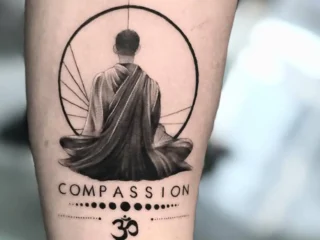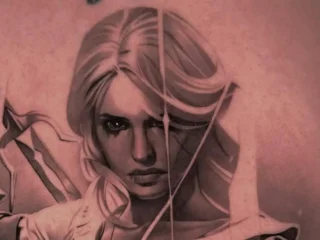

The most true-to-life digital tattoos of all time come to video gaming this month with the release of Army of Two: The Devil’s Cartel. Thousands of bits’ worth of tattoos have been in video games, but up until now they have been wholly lackluster, inaccurate, and rote. That all changes with Electronic Art’s third installment of the Army of Two series. In the new game (which has been described as Steven Seagal in a Michael Bay movie), operatives Alpha and Bravo, working for Tactical Worldwide Operations, have to meddle with a Mexican drug cartel.
“Tattoos have a lot to do with the underpinnings of the game,” says Robert Clarke, the art director for Army of Two. “Our main characters are private military contractors, and PMCs are usually former law enforcement or military, and tattoos are a big part of that culture. When you’re in that line of work and you go through trials and tribulations, your tattoos really express something that’s happened in your life that is very significant.” Part of the experience of Army of Two is the ability to customize the characters by choosing from a bank of outfits, masks, and now tattoos. “I have tattoos, a lot of us here have tattoos,” Clarke says. “It’s a beautiful art form, and so to get the most authentic look, you really have to work with professionals who could take the restrictions of the video game world and work within those bounds.”
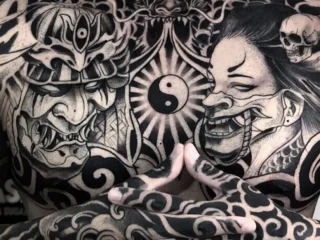
With that in mind, about a year ago, Electronic Arts approached INKED with a bold proposal: Instead of having digital designers craft tattoos, they wanted some of the best tattoo artists in the world to create ink for in-game characters. We reached out to horror tattoo legend Paul Booth and West Coast black-and-gray wizard Steve Soto and asked them and guys at their shops, Last Rites Gallery and Goodfellas Tattoo, to outfit the Army of Two boys Alpha and Bravo.
“I am a big fan of the art in video game graph- ics that my son plays,” Soto says. “And I love the concept and graphics in Army of Two.”
“I played around with a similar idea of my own a while ago, so when the idea was presented to me I was all in,” Booth says.
Clarke was thrilled to have them on board. “This isn’t just Joe Six Pack tattoo guy down the street who’s drawing standard flash; these [artists] are one in a handful,” Clarke says. “They’ve got a look that immediately you look at, and you know that’s those guys.”
So it was off to rendering for Booth and Soto. “I draw daily; I eat, sleep, and breathe art, so this was nothing new to me,” Soto says. “The drawing process was primarily the same, maybe a bit more refined, for the final piece of art. And then the tattoos were laid out on the templates using Photoshop instead of tattooing an actual live client.”