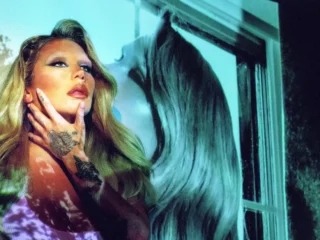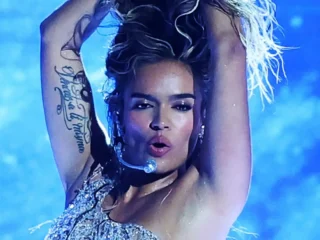



t just 26, singer-musician Michelle Branch has had a career with as many chapters and incarnations as someone twice her age. Her major label debut, The Spirit Room, came out in 2001 and featured the massive hit “Everywhere,” which can be heard today in those ubiquitous commercials for Chase Bank (“’Cause you’re everywhere to me/And when I close my eyes it’s you I see”). Just one year later, her collaboration with Santana, “The Game of Love,” won the Grammy Award for best pop collaboration with vocals. And in 2003, at 19, Michelle was nominated for another Grammy—this time for best new artist (she lost to Norah Jones).
It was quite a meteoric rise in a time when female pop vocalists like Britney and Christina ruled the airwaves—and the MTV video landscape—with frothy, contrived bubblegum dance tracks. Michelle was the anti-Mouseketeer: a rootsy singer-songwriter who wasn’t afraid to strap on a guitar and bust out an acoustic set at a local bar. She was pretty, yes, but it was an approachable attractiveness that made her more girl next door than girl on a poster above every teenage boy’s bed.
In 2003, the single “Are You Happy Now?” from her album Hotel Paper was Grammy-nominated for best female rock vocal performance. During that time, Branch also tried acting, with roles on Buffy the Vampire Slayer and Charmed. Then, just as quickly as she’d risen, Michelle seemed to disappear from the mainstream scene—first getting married, then having a baby, then putting out a country album under the name The Wreckers. Although the Wreckers song “Leave the Pieces” was Grammy-nominated (noticing a theme here?) and Branch’s new country duo was touring with genre superstars Rascal Flatts, some of her fans were confused, wondering, Where’s that cute girl we knew and loved from MTV?
Today, nearly 10 years after her music hit the landscape, Branch is the first one to admit that her career has been a wild ride. Now she ping-pongs back and forth between Nashville and Los Angeles with her husband, Teddy (the bass player in her touring band), and their 4-year-old daughter, Owen, and is anxiously awaiting the release of her next album, Everything Comes and Goes. It’s been in limbo for, well, longer than she would like (more on that later).
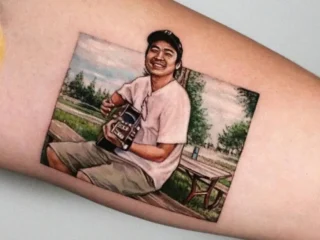
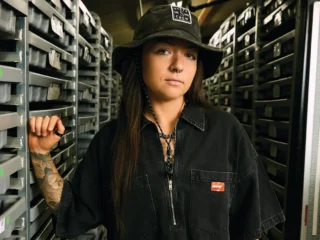
A charming raconteur who doesn’t take herself too seriously, Branch agrees to chronicle her various life chapters—and their corresponding tattoos—thus far. “I have 13 tattoos,” she says proudly. “I call them stickers. It started off when I was younger, getting smaller random stickers all over my body.”
Chapter One: Precocious Schoolgirl
Tattoo: Blue musical note on her left shoulder
Growing up in a middle-class family in Sedona, AZ (“a tourist town, very New Age hippy-dippy—a weird place to grow up”), Branch hated going to class because it interfered with her passion: playing music. She started taking voice lessons when she was 8. “I was always singing and writing melodies on my cheesy little keyboard,” she says. “My parents didn’t want to buy a piano because they didn’t think I’d stick with it. It’s obviously a much bigger purchase than a guitar. I kept begging for a piano, and when I realized that wouldn’t happen I started begging for a guitar.” She got her first guitar on her 14th birthday—a hand-me-down from her uncle. She was instantly obsessed. “I was locked in my room with it, and a chord book, and about a week later I came out in the living room and said, ‘Mom, Dad, I have something to play for you.’ When I finished they were like, ‘Oh, cool, what song is that?’ I’m like, ‘I wrote it.’ It was a very teenybopper love song called ‘Fallen.’ My favorite part about high school was writing songs about boys. And that was when they knew I needed that guitar.”
In school, Branch was that girl—an outcast who dressed in baggy pants and Beastie Boys T-shirts and blew off math class to practice her songs. “I would come to school with my guitar and play in the hallways, and everyone knew, That’s Michelle, she sings,” she says. “I was so focused on music, there wasn’t room for much else. I would ditch every class and either they would find me in the choir room or in the theater. I remember at one of my parents’ first parent-teacher conferences, they showed up to my algebra class, and the teacher said, ‘Um, she’s flunking algebra because she hasn’t been showing up for class,’ and then the drama teacher came in and said, ‘She’s not technically in my class, but she’s getting an A.’” Branch’s determination to forge a music career alienated teachers and guidance counselors. “No one would give me any support outside my house, my parents. It was really frustrating.”
Branch’s rebellion didn’t just come across in her music. Her father owned a building that was rented out by a tattoo parlor, and one day, when she was 15, she finally convinced him to let her get her first tattoo. “Looking back, I’m so surprised he let me do that,” Branch says. “My dad knew that music was gonna be part of my life, because I’ve been singing since I could talk. I think he was fine with the music note. His thought was, If I let her get this out of her system, she’ll be done. But as anyone with tattoos knows, that’s just making it worse. Once you have one, there’s no going back. I can’t remember the name of the tattoo artist, but I remember she was so nervous because my dad was there as I was getting it. She wasn’t excited to be doing it.”
As she became more serious about her music (she also plays the cello, the piano, and the drums), Branch, who was then a sophomore, decided to drop out of school. “Finally, one night at dinner, my dad turned to my mom and said, ‘You know, why does she have to go to school?’ So I left.”