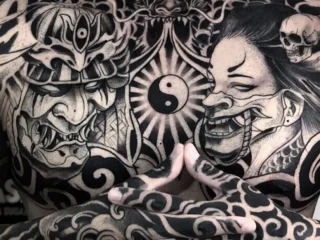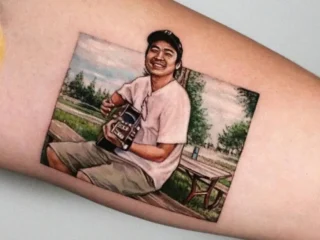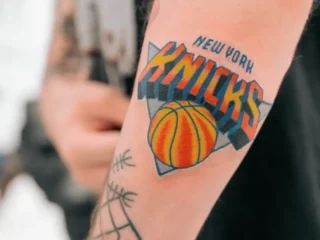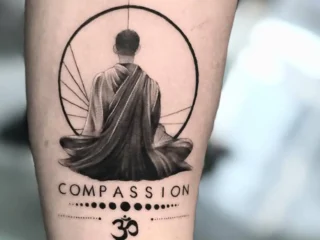


First, did the artist create the tattoo design independently or was it a collaboration with the client? If they did collaborate, both could be joint copyright owners, meaning they each have a right to do whatever they want with the work independently. In that case, the artist or the client could decide to license the use of the design for free, or they could each try to make some money off of it. But if either of them did make money from licensing the design, the law says that profits would need to be split.
If the tattoo was not a collaboration because a client brought in an original design, the client may believe he or she is the true owner of the design and that the resulting tattoo is a “work for hire.” But that’s a misconception. In order for a tattoo to be considered a work for hire, both parties must have agreed in writing that it’s a “work for hire” and the commissioned work has to fit the uses listed under copyright law—two things that don’t seem to apply to tattoos. (However, the “work for hire” argument could apply if the owner of the shop where the artist works claimed rights to the tattoo, but only if the tattooist working for that shop fits the definition of an employee.)
So that brings us to the question most people with tattoos want to know: If a tattoo isn’t a collaboration or considered a “work for hire,” what rights does the wearer of the tattoo really have? For example, should Tyson have to cover his face every time there’s a camera around because someone else owns the right to his tattoo and he no longer has the right to publicize it?
Many legal scholars—as well as the Warner Bros. legal team and Kahn—argue that a client, such as Tyson, has an implied license in the tattoo, meaning he has the right to display the tattoo, even in front of cameras, without permission. Kahn explains why: “When you apply a work of art to a visible part of a person’s body, whether a celebrity or not, there’s an implied license that, so long as that tattoo stays on that person, it becomes part of that person’s identity and that person can go wherever that person wants.” Meaning, if Warner Bros. wants to put Tyson in a movie or Tyson wants to go back to boxing, he doesn’t have to get the tattoo artist’s permission to have cameras film him.
However, Kahn explains, “If you took the actual piece of art off of Mike Tyson, that’s when you were making an unauthorized copy.” So it could be argued that taking the tattoo off of Tyson and putting it on Helms’s character in The Hangover 2 and its advertising was not unlike taking the tattoo off Tyson and putting it on a piece of merchandise to be sold for profit. And, to make matters even more complicated, since Tyson’s tattoo has become such a big part of his identity, it could even be argued that if the design were used without permission to sell boxing gloves, Tyson himself could potentially sue the company for violating his right of publicity since that right protects someone whose identity has some commercial value (Tyson) from having others (the makers of the boxing gloves) cash in on their name, likeness, and other indicators of their identity.
What does this mean for you? Simply put, you’re free to display your tattoo as you want, but those who designed the tattoo would be the ones who could profit from that design should it be used somewhere other than your body or perhaps even on your body if the tattoo is commercially exploited.
Your artist, however, needs to be more careful—especially when it comes to inking images of famous people on the skin of others. Consider the portrait tattoo for a moment: If Marilyn Monroe were still alive, and she believed that Megan Fox was becoming more famous (and making money) in part due to her tattoos—including the one with Marilyn Monroe’s likeness—then Monroe herself might have a case that the artist who inked Fox was violating her right of publicity by copying her image without permission. Of course, there is the right of free speech and artistic expression to be considered, but for tattooists commissioned to do celebrity portrait tattoos, it’s still best to add creative elements that transform the work so it’s not an exact photo-realistic copy, but more of a caricature or artistic commentary on the original image so that it falls under the doctrine of fair use.
In fact, fair use was a major argument of the defense in the Warner Bros. and Whitmill case. Warner Bros. claimed the tattoo on Helms’s character was intended to be a parody so it was protected as fair use. It was one of their stronger arguments, but it was heavily debated by legal experts in the press because parody, and fair use in general, is a big gray area of copyright and trademark law. Judge Perry noted that she wasn’t buying Warner Bros.’s fair use argument: “This use of the tattoo did not comment on the artist’s work or have any critical bearing on the original composition. There was no change to this tattoo or any parody of the tattoo itself. Any other facial tattoo would have worked as well to serve the plot device.” (It should be noted, though, that some experts disagreed with the last sentence.) Still, the case never went to trial and was settled out of court, so the issue was left undecided.
And since the issue is still undecided, artists need to be mindful not only when they’re tattooing images of famous people on skin, but also when they’re tattooing famous people at all, as two other cases settled outside of court have shown. In 2005, Portland, OR, tattooist Matthew Reed sued Rasheed Wallace and Nike to stop them from using the custom tattoos he designed for the basketball star in a Nike sneaker ad that focused on the tattoo and even simulated its creation. Also in 2005, U.K. tattooist Louis Molloy threatened to sue David Beckham if he went ahead with a promotional campaign that focused on a guardian angel tattoo Molloy did for him. With no clear answer on how judges would decide in these cases, the athletes and artists decided to settle outside the courts.
The settlements in all the aforementioned cases are confidential, but it can be assumed that some serious money was involved. The details are complicated—and dependent on when the artists filed for copyright registration—but statutory damages for copyright infringement can range from $750 to $30,000 and can be as high as $150,000. Plus, actual damages could include any profits of the infringer that are attributable to the infringement as well as a fee for damage to the artist’s reputation. Whatever this amount may add up to, it’s likely cheaper and easier for tattooists to be paid a licensing fee for their designs in certain cases. And the easiest solution of all? Having artists and clients set out the rights to their tattoo designs in advance—whether it be a license or an assignment of full ownership—so they can decide who owns the tattoo before the courts do it for them.