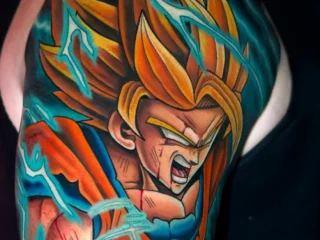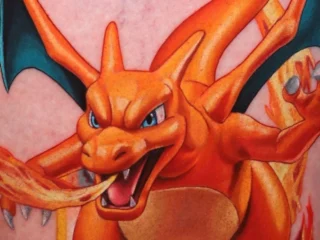



Almost like a tattoo gene?
That’s exactly it. Knowing how science has advanced over the centuries, maybe they’ll figure it out, and at some point go, “Yes, this is what it is.” But right now, the best we can do, and what we all have done, is emphasize the positive aspects and put it into a better social context. That’s much more important than who is the best tattooer. We have to look at the bigger picture. Of course, that’s important too—people striving to further the art and do stuff that’s going to be more interesting.
In the documentary, it’s said that your Realistic Tattoo Studio sparked an art movement. Could you discuss that a bit more?
I think it did. My whole deal, getting into tattooing in a nutshell, was to do something really different with it, offer people something that was way beyond the standard recipe on the walls of shops. It was all pretty much one flavor with some variants, but more or less folk art. That’s why, instead of going to graduate school and teaching art, I wanted to do that. After a number of years tattooing the street, tattooing in Vancouver and Seattle and then San Diego for four years, I went to Japan and experienced that firsthand working in a private studio. Although when I got there I realized that basically, they have their menu too; this place serves Japanese food. But it broadened my perspective. I came back and thought I could probably make it work in San Francisco or L.A. or New York because there was a large enough population base in those places of people with enough alternative perspectives on life that they would maybe be interested in tattoos that were unique. So in 1974 we built this private studio in San Francisco, with the urging of my wife, Francesca, and it quickly took off. I began building a base of people, really by word of mouth of like-minded people. Because of the Bay Area’s great tradition of bohemianism and eccentricity and alternate lifestyles and outlooks, it was a real fertile place for it. I was also getting a number of tattooers as clients from around the world pretty quickly—people who were often doing good work themselves and certainly interested in doing it. It was like they took the seeds of it and went, “Whoa, maybe I can go home and do this in my turf.” … It kind of spawned things and took off that way. In that sense, I think it was an art movement—a conceptual way of doing commissioned work instead of offering something cut-and-dried off the wall.
Along those lines, would you say tattooing itself is a fine art?
Lyle Tuttle gave an interview recently in a newspaper, and I loved this statement he made: “Listen, it’s a practice. I’m tired of hearing it being called an art. It’s a practice because a lot of it is just crap.” I have a hard time with those categories of what is a fine art, and I do have a built-in chip on my shoulder from art school. I got my degree in printmaking. Printmakers and those into ceramics were looked down upon by people who were like sculptors and painters. Any kind of elitist thing, which is a natural human tendency, just stinks. The work has to stand up on its own merits. Tattooing can be a fine art. It can be sublime, moving, inspirational, or funny—all the qualities that any kind of art could be in the right hands. It also has that supercharge that nothing else has. A person looking at a tattoo is not looking at a mute painting. Some people even think they can start touching it.
Oh, hey! One of my favorite stories of Mike Malone, my great brother in the business—a very funny cat—is about a woman who came into China Sea Tattoo, the Honolulu shop he took over from [Sailor] Jerry when he died. The woman was in there talking to someone else and then just reached up and pulled Mike’s sleeve up to see his tattoo. He turned around, didn’t even lose a second, and pulled down her tube top. She flipped out and is going, “I just wanted to see it,” and he said, “Yeah, me too!” There’s that electricity, that particular kind of thing that you don’t have with inanimate art.
Do you think today, especially with all the competition, it helps to have an art background before tattooing?
I certainly think, for me personally, that it really helped. But I wouldn’t say you have to to be a good tattooer. Certainly the great art impulse must come from within, really. As corny as it sounds, I really think it’s better to be driven to do art because you have to. There’s no one course that’s better than another, but I think the passion has to be there for it to really count.
Is a traditional apprenticeship necessary?
I know almost no one who went through a traditional apprenticeship. The usual way of people my age was you pestered somebody until they told you something. That’s what I did. I had gone to Bert Grimm’s and he wouldn’t tell me anything because I was still little—I was 10—and he told me to come back around when I was 15. I bothered Phil Sparrow. And then I met Tom Yeomans, a great tattooer who worked with Jerry. People started helping me and I bullshitted my way into it. I know there are real traditional apprenticeships, but a lot of times I hear people go so off the deep end with the great masters, especially the Japanese. They want to be the great Hori or sensei and they put their “you’re my apprentice” on and they’re just strutting around. They take themselves way too seriously.