
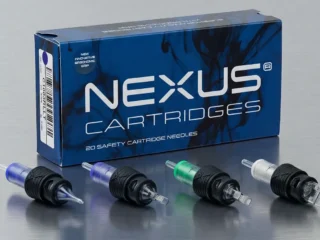
Plus, owning a patent is a cool thing to brag about. [Laughs.] The ego boost! In fact, my parents, who have never been that proud of my tattooing, will tell people that I’m an inventor before they’ll tell them I’m a tattoo artist. It makes things easier on them.
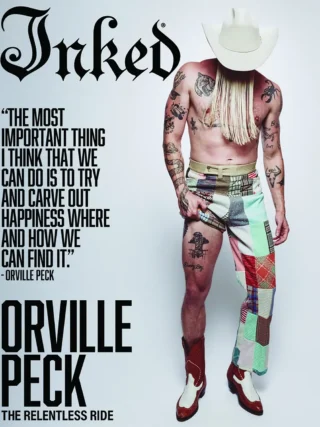
And hopefully when the technology is there you’ll be able to do something with that patent—you’re just a little ahead of the game right now. A big part of the luck and circumstance of my career comes from being just a little bit ahead of the curve. I got in with Mike Malone, who is the guy who bought Sailor Jerry’s shop when he died, so I have this patriarchal lineage of Sailor Jerry, Mike Malone, and then myself. There’s an honor just being involved in that. I try to honor the shit that came before me. Honor the people, the style, and the way of doing things. All those guys were street shop guys doing 10, 12 tattoos a day. Working hard and busting their asses doing little tattoos for the masses. It’s that work ethic that was part of what led my friend and business partner Oliver Peck and I to go on Warped Tour.
What was it was like to be touring around the country with Warped Tour as opposed to working in a regular shop? Oliver had the hookup with Vans from designing shoes for them. At the time we were both pretty heartbroken; he had divorced from Kat [Von D] that year and Mike Malone had committed suicide around the same time. I was ready for anything. I was heartbroken. I had found Mike a few days after he had shot himself and I was really fucked up over it and it led to a pretty serious pill addiction. Oliver had the idea to go on the road and tattoo—it sounded perfect to me. We got in an RV and hit the road. It was absolutely the best thing for me. It was as close as you can come nowadays to being a carnival tattooer, like it was in the 1920s. We would tattoo all day, go to sleep, and wake up in another parking lot and do it all over again. It was going back to the roots of tattooing in America for me. I absolutely loved it.
You mentioned that the death of Mike Malone led to some addiction problems. I suffered from a broken heart and drug addiction for a couple of years, and it really fucked up things good. I was a sober guy for 13 years, from about 17 to 30. Then when Rollo died I just lost my mind. The last year or so I’ve been clean again and getting back into what I do well. It was a really hard thing to go through.
Not to say that addiction is ever a good thing, but there are certainly situations where you don’t begrudge someone for developing a problem. Absolutely. I lost a lot of friends during that time because of some poor business decisions, and it was never an intentional slight of someone. I didn’t get things sent out on time or at all. When you are in that condition you don’t even remember what is going on. The last year I have spent a lot of time making up for the three years prior. Getting machines out that I have owed somebody forever and paying back debts and doing all the things it takes to get back square with people. Lucky for me, the tattoo world is perfect for forgiveness of drug addiction. If the tattoo world can’t forgive a drug addict, I don’t know which world can.
When you opened your shop in Chicago, Taylor Street Tattoo, you went through a lot of hassles with the city, right? Surprisingly, it wasn’t the city giving me problems; it was St. Ignatius [Church] and the University Village Association. Originally I tried to open a shop on the other side of the street and I failed miserably. I just didn’t understand Chicago politics. I rented a storefront for a few months and completely failed when trying to get the zoning.
Yet you weren’t deterred by the failure. I had enough money to buy a building this time. I went in and bought the only place I could afford and decided I’m going to go through it and not take any chances. I donated money to St. Ignatius and joined the [University Village Association] before I even applied for the license. Even though tattooing is a legal business they started working against me, saying no one in the neighborhood wants it. I made campaign contributions to the alderman, congressman, and anyone I could think of. The headmaster of St. Ignatius showed up to say that people like me didn’t care about the community. The greatest thing was that I already had two years’ worth of thank you letters from my contributions, essentially saying thanks to business owners like me who care about the welfare of our children. In court they looked foolish and we won. Once I was able to open up I could show that their ideas about the business were wrong.
Their entire case against you was built on assumptions of what the tattoo industry was. Exactly. The fears they had were insane. They thought I would be open until two in the morning with 20 motorcycles parked out front. I have kids, I’m gonna be closed at 10—get a grip. When we went to court again I won, and they finally gave up.
How did you end up having a shop down in Austin as well as in Chicago? My wife is from Austin and she conned me into buying a house here in 2006. [Laughs.] So I had a house down here already and after Rollo killed himself I just wanted to get out of Chicago. I realized I wasn’t traveling to Chicago enough and I was getting bored. I tried to work in a couple of shops for friends here, but once you’ve been the boss it’s really hard to not be the boss, so that didn’t work out. I bought a struggling shop here, renamed it, and it’s been about three years now and I do both. It’s craziness but it works. The worst thing to happen to me was to have my friend die, get a bunch of money I didn’t earn, and develop a drug problem with no job and nothing to do. The best thing for me is to stay busy.
I assume that it was the desire to stay busy that led to you start a record label as well, right? Right. After Warped Tour I had made all these connections with musicians, so that’s how End Sounds got going. I got a lot of offers from musicians who wanted to do side projects or solo things and I thought about how cool it would be to be in the music industry. I thought about starting my own label, but instead I met Jonathan Gill, who was pretty established, and I bought half of the label. He knew all the business and distribution while I knew a lot of talent. Some of the things on the label include Mike Herrera’s Tumbledown, Andy from Hot Rod Circuit has a project, and Bill Stevenson from the Descendents has a project called The Mag Seven that we put out. It’s that sort of a label—established artists who have side projects that they want to get out there. We don’t make much money, but it’s fun and we survive.
What are some of the differences between your two shops, Austin Tattoo Company and Taylor Street Tattoo? Austin Tattoo Company is a totally different kind of project. Taylor Street was started from scratch, and ATC was already a shop that I bought and had to deal with the bad reputation and different things. It had previously been a custom shop and I’m a street shop guy, so I had to knock down walls so you could see everything and put flash up and turn it into a shop that I knew how to run. I hired some young kids who were hungry, and we’re hitting it. I hope that I’m passing on my knowledge that way.
You seem to be very aware of paying homage to your roots and where you have come from.There have just been so many people who have had great influence on my career like, Mike Malone, Nick Colella, Josh Arment, and, of course, Oliver [Peck]. There have been a lot of great people who I have had relationships with, some I’ve lost relationships with. It’s really important to me that people know I’m aware of that. It’s a weird thing to be cocky and humble at the same time. I think I have the right confidence about it. I think you need to be really confident to be a tattooer. I’m also aware of the mistakes I have made and do my best to amend them.